Christmas traditions, looked up and double-checked.
Where our Christmas customs really come from: the word itself, Saturnalia, the tree, St Nicholas and Father Christmas, the first card, the cracker, A Christmas Carol, the Manx Oie’l Verrey and Hunt the Wren, and Christmas around the world. For KS2 and KS3 topics, families, quiz fans and anyone who has ever argued about Twelfth Night. Every fact links to its source, and where sources disagree we show both.
The short version
The word Christmas means “Christ’s mass”. It comes from the Middle English Christemasse, which came from the Old English Cristes mæsse. Encyclopaedia Britannica: Christmas
The church in Rome began formally celebrating Christmas on 25 December in 336, in the reign of the emperor Constantine. Encyclopaedia Britannica: Christmas In the 3rd century, the Roman Christian historian Sextus Julius Africanus dated the conception of Jesus to 25 March, which would give a birth date nine months later, on 25 December. Encyclopaedia Britannica: Christmas
At the start of the 19th century, Christmas was hardly celebrated in Britain, at least not in a way we would recognise. By the end of the century it was the biggest yearly celebration in the British calendar. V&A: Victorian Christmas traditions
In the Isle of Man, Christmas was a break from hard work called the “Foolish Fortnight”, in Manx Gaelic “Yn Kegeesh Ommidjagh”. Culture Vannin: Kiaull Manninagh Jiu, December 2016 (Manx music and dance at Christmas)
Start exploring
Pop goes the cracker
The Christmas cracker was invented by Tom Smith (1823–1869), a London confectioner and baker who set up shop in Clerkenwell in the 1840s. V&A: The Christmas cracker On a trip to Paris, Smith saw French bonbons: sugared almonds twisted in tissue paper. He started adding a little motto inside the wrapper. V&A: The Christmas cracker The idea for the “pop” is said to have come from the crackle of a log fire. V&A: The Christmas cracker
A Manx Christmas Eve
Oie’l Verrey (also spelt Oie’ll Verree) means the Eve of the Feast of Mary: Christmas Eve. After the evening service, the parish clerk and congregation stayed in church to sing carvals, carols in Manx Gaelic. Culture Vannin: Kiaull Manninagh Jiu, December 2016 (Manx music and dance at Christmas) More on Christmas in the Isle of Man.
Enjoying the facts? Help keep the fairy lights on.
This site is hand-built, fact-checked and free to read. If a fact, a game or one of Useless’s notes made you smile, a little support keeps it going and helps the network grow.
Christmas traditions printables
Fact-checked PDFs in A4 and US Letter, for KS2 and KS3 classrooms, home learning, quiz nights and families.
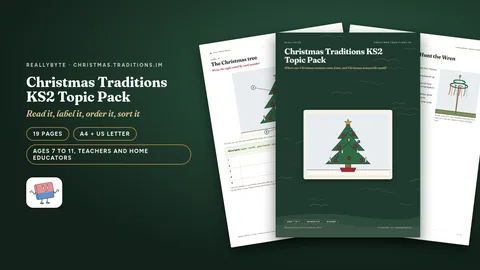
Christmas Traditions KS2 Topic Pack
Ages 7 to 11, teachers and home educators
Worksheets on where our Christmas customs come from: the word Christmas, Saturnalia, the tree, St Nicholas and Father Christmas, the first card, the cracker, A Christmas Carol and Christmas around the world, with a label-the-tree page, cut-out order and sorting cards, a true-or-false quiz, a word search, a certificate and answers. Every fact sourced.
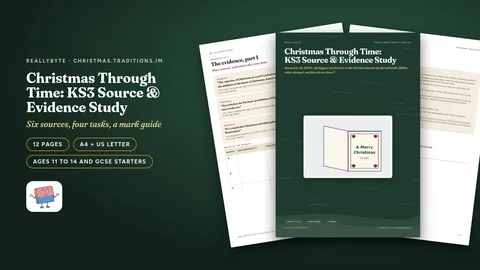
Christmas Through Time: KS3 Source & Evidence Study
Ages 11 to 14 and GCSE starters
A source-based study of how Christmas changed, from the 1640s ban to the Victorian Christmas: short quoted extracts from Historic England, English Heritage and the V&A (including a line from Henry Cole’s 1843 diary), with inference and chronology tasks, a “when sources disagree” task (who brought the tree? who sent the first card?), a judgement question and a mark-yourself guide.
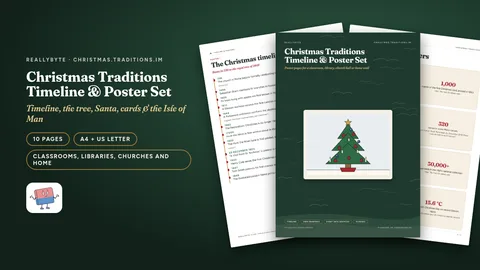
Christmas Traditions Timeline & Poster Set
Classrooms, libraries, churches and home
Poster pages: a two-page timeline from 336 to 2010, the Christmas tree, St Nicholas, Santa and Befana, the Victorian Christmas, Christmas in the Isle of Man, and Christmas in numbers. Every date sourced.
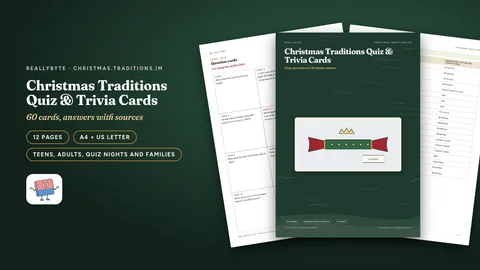
Christmas Traditions Quiz & Trivia Cards
Teens, adults, quiz nights and families
Sixty cut-out quiz cards on Christmas customs, from Saturnalia and St Nicholas to crackers, carvals and the first royal broadcast, each answer with its source, plus a score sheet and tie-breakers.
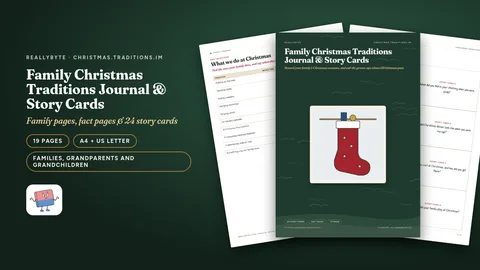
Family Christmas Traditions Journal & Story Cards
Families, grandparents and grandchildren
A keepsake journal for recording your own family’s Christmas customs, plus cut-out story cards to ask grandparents and older relatives about Christmases past. With short sourced fact pages on how the tree, cards and crackers began, and pages for photos, drawings and notes.
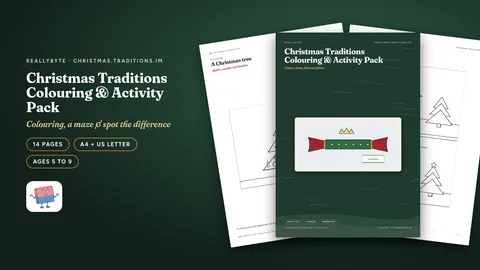
Christmas Traditions Colouring & Activity Pack
Ages 5 to 9
Colouring pages drawn by us (a Christmas tree, a cracker, a Christmas card, St Nicholas, Befana’s broom, a Manx wren pole and a poinsettia), each with one true fact, plus a maze, spot the difference, design-your-own cracker and answers.
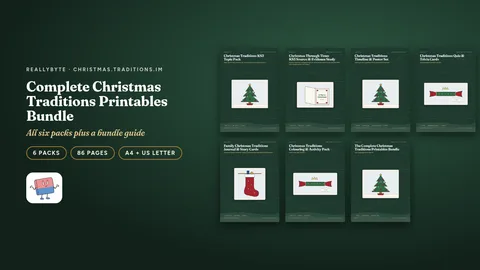 Best value
The Complete Christmas Traditions Printables Bundle
All six packs plus a bundle guide, A4 and US Letter, in one download. $12.99 instead of $26.94 bought separately.